Burn first aid at home: the first ten minutes decide the scar
Almost everything that improves the outcome of a burn happens in the first few minutes, at a cold tap, before anyone has decided whether it is serious. Almost everything that makes it worse comes out of a kitchen cupboard.
A burn does not stop when the heat source is removed. Tissue holds heat and keeps cooking for some minutes afterwards, which is why cooling is not comfort care, it is treatment. Cooling early and long enough reduces the depth of the injury, reduces pain and reduces scarring. That is the entire logic of what follows.
This page describes generally accepted first aid. It does not replace medical assessment, and the list of burns that need professional care is deliberately generous.
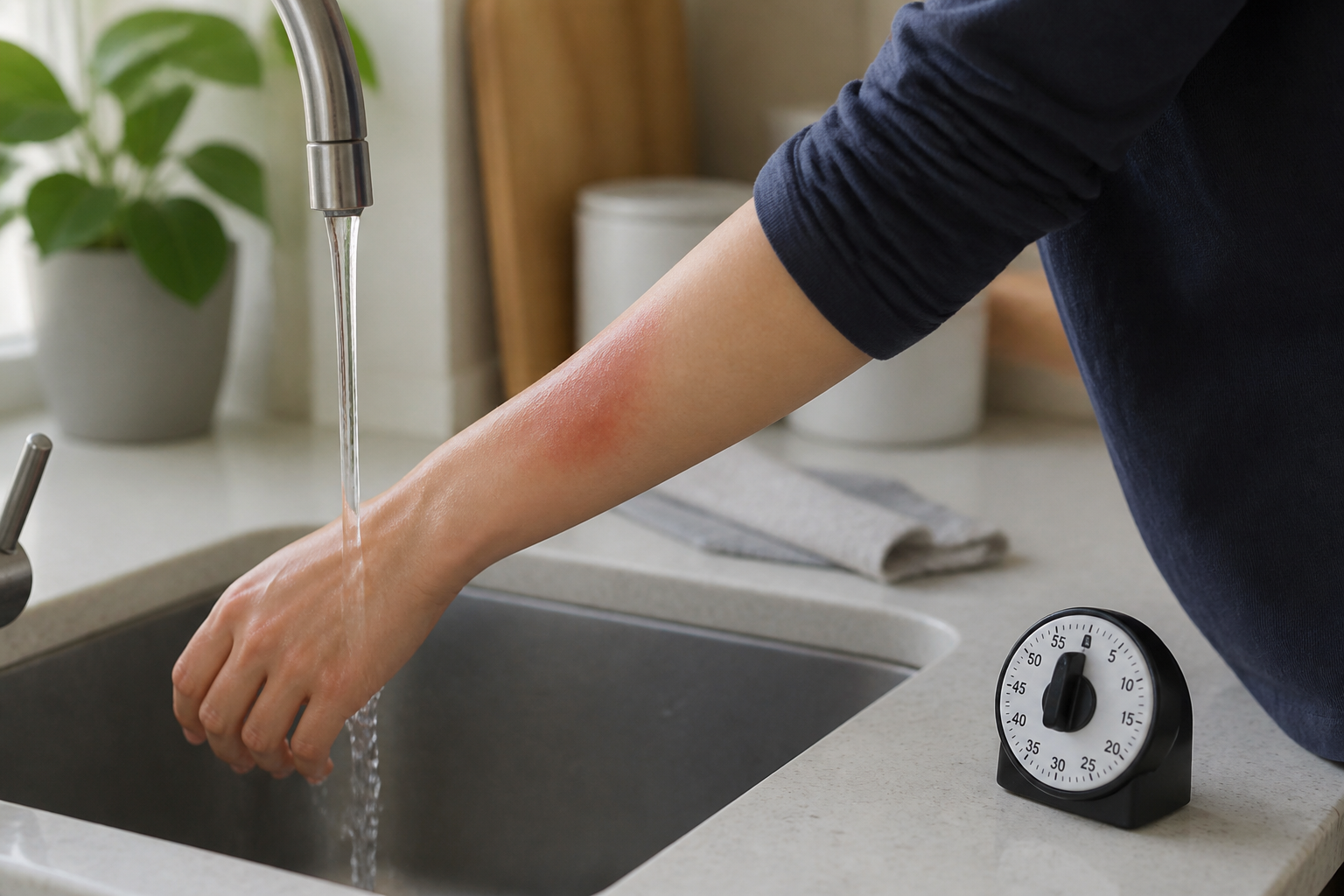
The first ten minutes
- Stop the burning. Remove the person from the heat, or the heat from the person. If clothing is alight, stop, drop and roll, or smother with a blanket.
- Get it under cool running water. Cool, not iced: a running tap or shower at ordinary cold tap temperature. Keep it there for at least ten minutes, and twenty is better. Cooling is still worth doing up to about three hours after the injury if you did not manage it at the time.
- Take off rings, watches, belts and tight clothing from the burned area quickly, before swelling starts. Do not pull off anything that is stuck to the burn.
- Keep the rest of the person warm. Cool the burn, not the patient. Large burns and small children lose body heat fast, so a blanket over everything else while the burn cools is not a contradiction.
- Cover loosely once cooled, with a clean, dry, non fluffy dressing, or cling film laid on in strips rather than wrapped around a limb. Nothing adhesive on the burn itself.
- Then decide about care using the list below, and give an ordinary painkiller if the person can take one.
Cool running water, ten to twenty minutes, nothing else on it, loose clean cover, then assess. Ice, butter, oil, toothpaste and ointments all make it worse.
What never goes on a burn
- Ice or iced water. It constricts the blood supply to already damaged tissue and can deepen the injury.
- Butter, oil, lard or grease. They hold heat in, which is precisely the opposite of the aim.
- Toothpaste, egg white, flour, mustard, soy sauce. Folk remedies that add contamination and make the burn harder to assess.
- Creams and ointments before assessment. They have to be scrubbed off before anyone can judge depth, and that hurts more than the burn did.
- Adhesive dressings or fluffy cotton wool. Fibres stick into the wound.
- Bursting blisters. Intact blister skin is a sterile dressing. Leave it.
Judging depth, roughly
| Depth | Appearance | Sensation | Usual course |
|---|---|---|---|
| Superficial | Red, dry, no blisters, blanches when pressed | Painful, tender | Heals in days without scarring, like ordinary sunburn |
| Partial thickness | Blistered, wet, red or mottled pink | Very painful | Needs assessment; may scar; deeper ones need specialist care |
| Full thickness | White, waxy, leathery, brown or charred, dry | Little or no pain in the burn itself, because the nerve endings are gone | Always needs emergency care and usually surgery |
The counterintuitive line in that table is the last one. A burn that does not hurt is a worse sign than a burn that does.
Burns that need an emergency room
- Any burn to the face, hands, feet, genitals, or across a major joint.
- Any burn that goes right round a limb, a finger or the chest.
- Any burn larger than the palm of the injured person's hand.
- Any burn that looks white, leathery or charred, or that does not hurt.
- Any chemical or electrical burn, however small it looks.
- Any burn to a baby, a small child, an older adult, a pregnant woman, or anyone with diabetes, poor circulation or a suppressed immune system.
- Any burn where the person has also breathed smoke or hot air.
- Any burn that starts to look infected: spreading redness, increasing pain, swelling, discharge or fever in the days that follow.
Soot around the nose or mouth, singed nose or eyebrow hair, a hoarse voice, a barking cough, black sputum, noisy breathing or confusion after a fire all point at an airway injury. Call 911. Airway swelling can develop over hours, and it develops fastest in children.
Chemical burns
- Protect yourself first: gloves if there are any, and do not become the second casualty.
- Brush off dry powder before adding water, or you will make an acid or alkali on the skin.
- Flush with gently running water for at least twenty minutes, longer for alkalis such as oven cleaner, drain cleaner and cement, which keep burning far longer than acids.
- Remove contaminated clothing and jewellery while flushing.
- For eyes, flush from the inner corner outward for at least twenty minutes and keep flushing on the way to care.
- Take the product container or a photograph of the label with you.
Electrical burns
Electricity leaves a small mark and does large damage. The visible burn at the entry and exit points can be trivial while muscle along the path is destroyed, and the current can disturb the heart rhythm hours after the event.
- Do not touch the person until the power is off at the breaker or the source is safely away. Wood and plastic are not reliable insulators at high voltage.
- Call 911 for any shock above household voltage, any shock that threw the person, any shock through water, and any shock in someone who lost consciousness, feels faint, or has an abnormal heartbeat.
- Assume there is an entry and an exit wound. Look for both.
- For overhead lines, stay at least ten metres away and let the utility make it safe. Do not approach a downed line for any reason.
Scalds, the household burn nobody counts
Hot liquid causes far more household burns than flame does, and small children take the worst of it because their skin is thinner and they cannot get out of the way. Three changes remove most of the risk.
- Set the water heater to about 120 °F. At 140 °F tap water can cause a serious scald in a few seconds; at 120 °F the same injury takes minutes, which is the difference between a fright and a hospital.
- Run cold water into a bath first, hot second, and test with your elbow or a thermometer before a child goes in.
- Cook on the back burners with pan handles turned inward, and keep hot drinks away from table edges and out of reach of a grabbing hand. A cup of tea is still hot enough to scald a toddler badly a full fifteen minutes after it is poured.
The childproofing page runs through the rest of the house on the same principle, and the extinguisher page covers the pan fire that produces many of these injuries in the first place.