Smoke alarms: how to test them, which sensor to buy, when to throw them out
Four questions cover almost everything people need from a smoke alarm: how do I test it, which type should I buy, how often does the battery change, and how do I know when the whole unit is finished. Here they are in that order, with the placement rules at the end.
A smoke alarm is the only piece of equipment in the house whose entire job is to wake you. Everything else on this site assumes that job was done. It is also the piece of equipment most likely to have been quietly disabled, because a chirping alarm at two in the morning is genuinely maddening and pulling the battery genuinely stops it.
Research published year after year by the National Fire Protection Association keeps landing on the same finding: around three of every five deaths in home fires happen in homes with no smoke alarms at all, or with alarms that did not operate. Missing alarms and dead alarms are, between them, the largest single controllable factor in whether a house fire kills anyone.
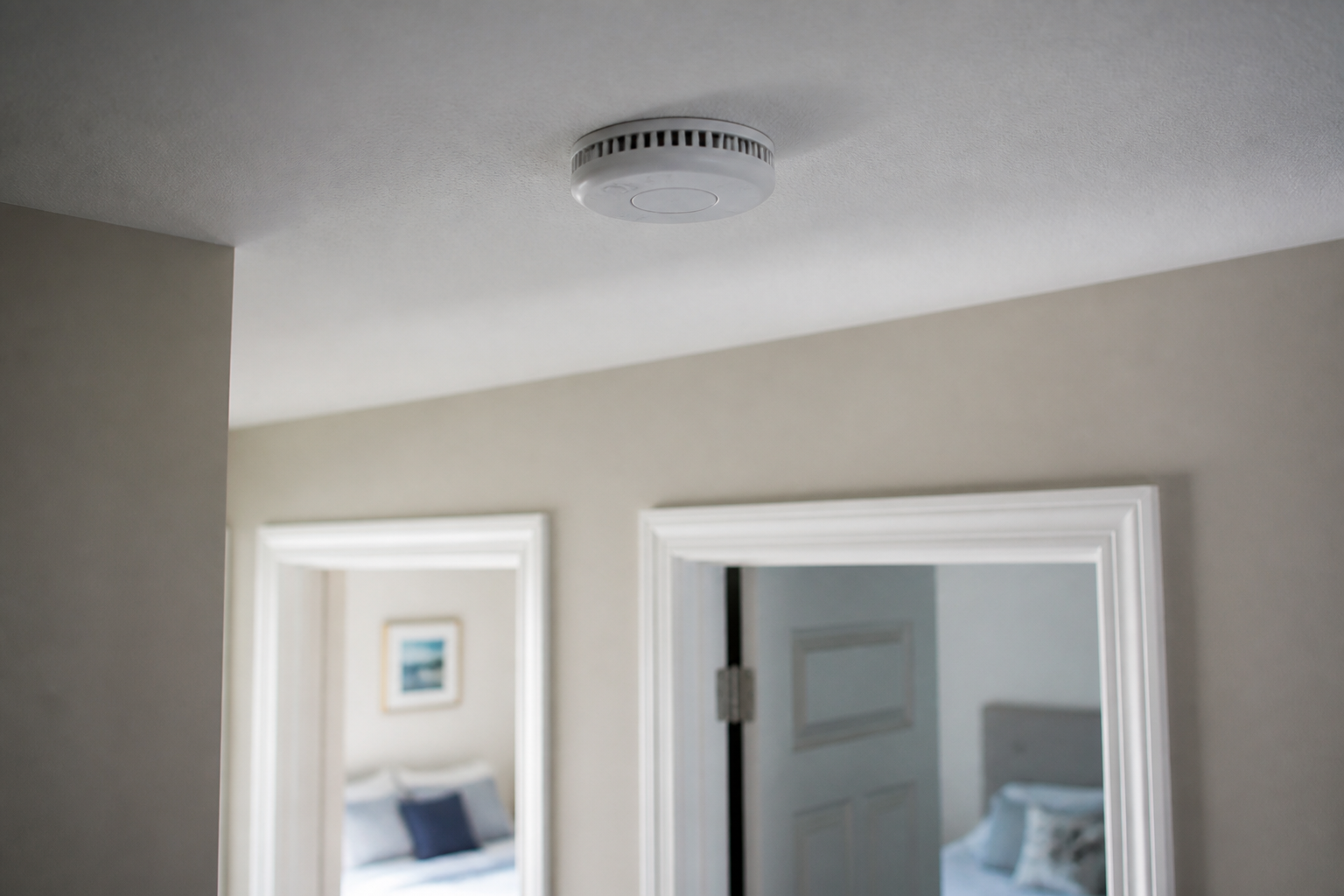
How to test a smoke detector
Once a month, and it takes about thirty seconds per alarm.
- Tell everyone in the house first, especially small children, so the noise is expected rather than frightening.
- Press and hold the test button until the alarm sounds. On most units that is one to five seconds; on some it is longer than feels reasonable, so keep holding.
- If the alarms are interconnected, stay in place and listen: every other alarm in the house should sound within a few seconds. If they do not, the interconnection has failed even though each alarm works.
- Release the button and let the alarm reset. Move to the next one.
- Anything that does not sound, sounds weakly, or sounds late gets replaced the same day, not added to a list.
What the test button actually proves
This is the part that surprises people. The test button drives the horn through the alarm's own electronics using the installed power source. It confirms three things: the battery or mains supply is live, the circuitry works, and the sounder is loud enough. It does not confirm the one thing the alarm exists for, which is that smoke can still enter the sensing chamber and be detected. Dust, cooking grease, paint overspray and insects all degrade that path, and none of them affect the test button.
If you want to test the sensor itself, use a canned aerosol sold and listed specifically as a smoke detector tester, following the direction and distance printed on the can. Do not use a candle, a match, a cigarette or smouldering paper. Real combustion products deposit soot inside the chamber and shorten the alarm's life, and open flame under a plastic ceiling fitting is a poor way to celebrate fire safety month.
Press and hold the test button on every alarm on the first of each month. Once a year, or after any renovation dust, also vacuum the outside of each alarm with a soft brush. Replace, do not repair, anything that fails.
Ionization against photoelectric
Two sensing technologies dominate residential alarms, and they do not fail the same way.
- Ionization sensor
- A tiny amount of radioactive material ionises the air inside a chamber, creating a small current. Combustion particles disturb that current. The design responds quickly to the very small particles produced by fast, flaming fires, for example a wastebasket or a pan of oil going up.
- Photoelectric sensor
- A light beam crosses a dark chamber and misses the sensor until smoke scatters it. The design responds quickly to the larger particles produced by smouldering fires, for example a cigarette in upholstery or wiring cooking slowly inside a wall.
- Dual sensor alarm
- Both technologies in one housing, sounding on either. This is the simplest way to cover both fire behaviours with one device per location.
The important point is that the two fire behaviours are not exotic edge cases. Both are common in homes, and the smouldering fire is the one most likely to start while everyone is asleep. The National Fire Protection Association's position is accordingly not to pick a winner but to have both technologies present in the home, either by installing both types or by using dual sensor units.
| Question | Ionization | Photoelectric |
|---|---|---|
| Fast flaming fire | Responds sooner | Responds, slightly later |
| Slow smouldering fire | Responds, often much later | Responds sooner |
| Nuisance alarms from cooking and steam | The more sensitive of the two | Less prone, though not immune |
| Best placed | Away from kitchens and bathrooms | Anywhere, including near kitchens and near bedrooms |
| Contains a sealed radioactive source | Yes, in microscopic quantity | No |
One practical consequence: if there is a corridor alarm that keeps going off when you brown onions, replacing it with a photoelectric or dual sensor unit, or moving it further from the kitchen, is a real fix. Taking the battery out is not.
How often to replace smoke alarm batteries
It depends on which of three kinds of alarm you have, and it is worth knowing which is on your ceiling.
- Replaceable battery alarms. Change the battery at least once a year, and immediately at the first low battery chirp. Test the alarm after every change, because a battery that is seated badly reads as installed and powers nothing.
- Sealed ten year lithium alarms. There is no battery to change. The cell and the alarm are designed to end together, and the whole unit is replaced at the end of its life. These remove the annual chore and the temptation to borrow the battery for something else.
- Hardwired alarms with a backup battery. The mains does the work; the battery only carries the alarm through a power cut, which is exactly when fires from candles and generators happen. The backup still needs its annual change unless the model uses a sealed ten year cell.
Whatever the type, the chirp is not a suggestion. A single chirp roughly once a minute means one of two things, and both need action today.
| Sound | Meaning | What to do |
|---|---|---|
| Three loud beeps, pause, repeating | Smoke alarm signal | Get everyone out, then call the fire department from outside |
| Four loud beeps, pause, repeating | Carbon monoxide signal | Everyone outside to fresh air, call 911, do not go back in |
| One short chirp about once a minute | Low battery, or the alarm has reached end of life | Change the battery; if the chirp continues, replace the alarm |
| Chirp that continues with a fresh battery | End of life announcement on most modern units | Check the date on the back and replace the unit |
The three beep and four beep patterns are standardised, which is why they are worth teaching to everyone in the house, children included. The carbon monoxide page explains why the response to four beeps is different from the response to three, and why opening the windows first is not always the right move.
The ten year rule, and where the date is printed
Smoke alarms wear out. The sensing chamber accumulates dust, the electronics drift, and the manufacturer's listing no longer covers the unit's behaviour. The accepted service life is ten years, and the clock starts at the date of manufacture, not the date you screwed it to the ceiling.
That date is printed on the back of the housing, so you find it by twisting the alarm off its mounting plate and turning it over. Alarms sitting in a warehouse or on a shelf for two years arrive with two years already spent. While the alarm is in your hand, write the installation date on the side with a permanent marker, on the housing and not over any vent, so that the next person does not have to take it down to find out.
An alarm older than ten years is replaced even if it passes its test, even if it looks new, and even if it was expensive. Carbon monoxide alarms run on their own, shorter schedule, commonly five to ten years depending on the model, so a combination unit follows whichever date comes first.
Where the alarms go
Coverage is defined by sleeping, because that is when people die in fires. The minimum, consistent across current United States guidance, is:
- One inside every bedroom.
- One outside each separate sleeping area, meaning the hallway or landing that serves those bedrooms.
- One on every level of the home, including a finished basement, even if nobody sleeps there.
- All of them interconnected where possible, so that one alarm sounding sets off every alarm in the house.
Interconnection is the upgrade people underrate. A basement fire detected by a basement alarm is of no help to anyone sleeping two floors up, and wireless interconnected alarms have made this achievable without opening a single wall.
Mounting details that change performance
- On a ceiling, keep the alarm at least 4 inches away from the wall, because the corner where wall meets ceiling is a pocket of relatively still air.
- On a wall, mount it between 4 and 12 inches below the ceiling, measured to the top of the alarm.
- On a peaked or cathedral ceiling, mount within about 3 feet of the peak measured horizontally, but not in the top 4 inches of the apex itself.
- Keep alarms away from supply registers, ceiling fans, exterior doors and windows, where moving air can push smoke past the sensor.
- Keep them clear of fixed cooking appliances where the layout allows it. Current practice is at least 10 feet, and in the zone between 10 and 20 feet a photoelectric unit or one with a hush button will save a great deal of aggravation.
- Do not put a standard smoke alarm in an attached garage, an attic, an unheated porch or a dusty workshop. Most are listed for roughly 40 °F to 100 °F in non condensing humidity, and outside that band they either false alarm or fail without telling you. Those rooms want a heat alarm instead.
Cleaning, painting, and the things that kill an alarm early
Alarms are cheap and their enemies are mundane.
- Vacuum the outside of each alarm with a soft brush attachment two to four times a year, and always after building work. Do not open the housing.
- Never paint an alarm, and never let a decorator paint the ceiling around it without taking it down. A film of paint over the vents blinds the sensor completely while leaving the test button working perfectly.
- Do not put stickers, tape or a plastic bag over an alarm to stop nuisance alarms during cooking or renovation. If it is covered, it is off, and people forget.
- Replace any alarm that has been through a flood, a grease fire, or a full renovation with the ceilings open.
If someone in the house does not wake to the sound
Standard alarms use a high pitched sounder, and it does not wake everyone. Research on waking effectiveness has repeatedly found that a proportion of children sleep through a standard alarm that wakes every adult in the room, and that lower frequency signals and recorded voice alarms wake sleepers more reliably. If your household includes deep sleeping children, a person who is hard of hearing, or anyone whose medication makes them sleep heavily, look for alarms offering a low frequency sounder, a voice message, a bed shaker or a strobe. The escape plan page covers who is responsible for waking whom, which is the other half of that problem.
A maintenance calendar you can keep
| How often | What to do |
|---|---|
| Every month | Press and hold the test button on every alarm; confirm the interconnected units answer |
| Two to four times a year | Vacuum the outside of each alarm with a soft brush |
| Once a year | Replace every user replaceable battery, including the backup in hardwired units |
| Every ten years | Replace the alarm itself, counting from the date of manufacture on the back |
| After a flood, fire or major renovation | Replace affected alarms outright rather than testing them |